
The Indian community in the Netherlands has nearly tripled since 2016, growing from about 32,700 people to roughly 89,000 by January 2024, according to Statistics Netherlands (CBS). Most of that growth has been driven by labour and family migration into the IT, engineering, and semiconductor sectors, with the country's Randstad and Brainport regions absorbing the largest share of new arrivals.
This piece pulls together the clearest, most current numbers CBS has published on Indian migration to the Netherlands: how the population has grown, who is arriving and why, where people are settling, what kind of work they do, and where the data runs out. Wherever a figure is an estimate rather than an official count, that is said plainly rather than dressed up as fact.
How Many Indians Have Moved to the Netherlands in the Last 8 Years
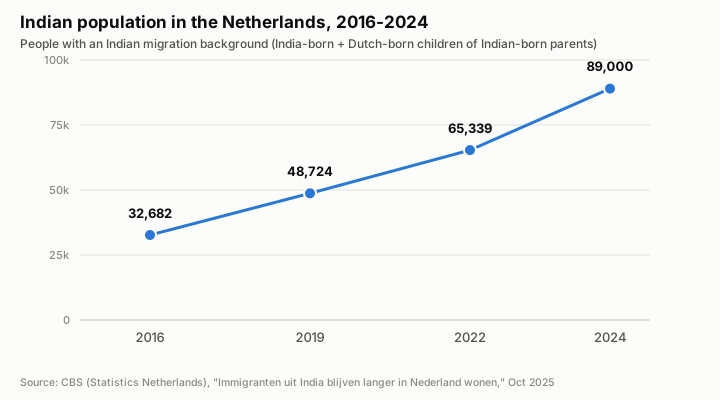
Between 2016 and January 2024, the Indian-origin population in the Netherlands grew from about 32,682 to roughly 89,000, a net increase of around 56,000 people over eight years. That is not a simple headcount of everyone who arrived, since some people who moved in also moved out again, but it is the clearest picture CBS's population registers give of how much the community has actually grown.
| Year | Indian-origin population (CBS) |
|---|---|
| 2016 | 32,682 |
| 2019 | 48,724 |
| 2022 | 65,399 |
| 2024 (1 Jan) | 89,000 |
Year-on-year arrivals have been uneven rather than steadily climbing. CBS's migration statistics show immigration and emigration moving in opposite directions in recent years: arrivals surged in 2022 as pandemic-era travel restrictions lifted, then began cooling.
| Year | Immigration (arrivals) | Emigration (departures) | Net migration |
|---|---|---|---|
| 2019 | 12,515 | 5,474 | +7,041 |
| 2020 | 6,163 | 5,022 | +1,141 |
| 2022 | 14,755 | 3,852 | +10,903 |
| 2023 | 12,277 | 4,419 | +7,858 |
| 2024 (provisional) | 9,392 | 5,411 | +3,981 |
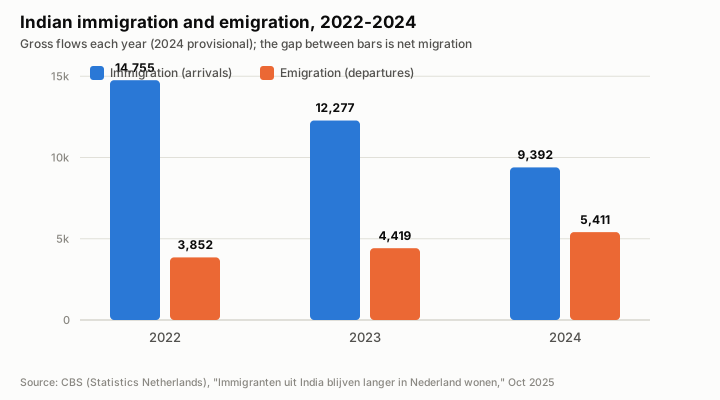
The direction of travel matters as much as the totals. 2022 was the peak year of the recent cycle, with almost 15,000 arrivals and net growth of nearly 11,000 people. By 2024, arrivals had fallen by more than a third from that peak while departures had risen, cutting net growth to under 4,000. DutchNews.nl reported that this slowdown continued into 2025, with the Indian population growing by only around 1,000 in the first half of the year, a sharp drop from the roughly 5,000 added over the whole of 2022. None of this means migration has reversed, it means the exceptional post-pandemic surge has settled back toward a steadier, slower pace.
How Many Indians Live in the Netherlands Today
CBS's most recent published count puts the Indian-origin population at 89,000 as of 1 January 2024, made up of about 74,000 people born in India and roughly 16,000 people born in the Netherlands to Indian parents. That is the latest official figure available at the time of writing. Given that net migration was still positive through 2024 and into 2025 (even if at a slower pace than the 2022 peak), the actual number living in the country today is likely somewhat higher than 89,000, but CBS has not yet published a newer official total, so this article does not guess at one.
One extra data point worth knowing: Indian nationals are increasingly staying rather than moving on after a few years. Of those who arrived in 2019, over 56% were still living in the Netherlands four years later, well up from the 33% four-year retention rate recorded for the 2011 arrival cohort. Family migrants stay at a notably higher rate (64.4% after four years) than labour migrants (50.3%), which tracks with the practical reality that a job can end but a household usually does not relocate as quickly.
Why Indians Are Moving to the Netherlands
Migration motives have shifted over the past decade. In 2013, labour was the dominant reason for moving (49.1% of arrivals), with family second (37.4%) and study a distant third (12.4%). By 2023, family had overtaken labour as the single largest stated reason for migrating.
| Motive (2023 arrivals) | Share |
|---|---|
| Family | 45% |
| Labour | 39.7% |
| Study | 15% |
| Other | ~0.3% |
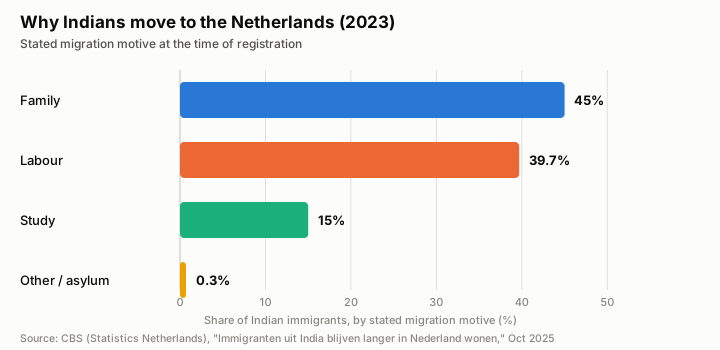
The rise of family migration alongside labour migration is a sign of a maturing community rather than a one-off wave: people who arrived earlier for work are now sponsoring partners and children, which is also consistent with the improving four-year retention rates above.
What Kind of Work Indians in the Netherlands Do
CBS and multiple independent sources consistently point to the same picture: the large majority of recent Indian migrants to the Netherlands work in information technology and information services, arriving mainly on labour contracts or the Highly Skilled Migrant visa route. Beyond IT specifically, the semiconductor and high-tech engineering sector, concentrated around Eindhoven's Brainport region, is a significant employer, alongside smaller but steady numbers in pharmaceuticals, finance, and academia (PhD and postdoctoral researchers arriving on study or research visas).
This sector concentration is also the reason two cities dominate the settlement pattern below: Amsterdam and its surrounding Randstad municipalities for IT, consultancy, and multinational head-office roles, and Eindhoven for semiconductor and hardware engineering.
Where Most Indians Are Living in the Netherlands
Relative to local population size, Indian residents are heavily concentrated in a small number of municipalities rather than spread evenly across the country.
| Municipality | Indian residents per 1,000 population (Jan 2024) |
|---|---|
| Amstelveen | 68.3 |
| Uithoorn | 49.6 |
| Eindhoven | 35.4 |
| Almere | 30.7 |
| Amsterdam | 11.8 |
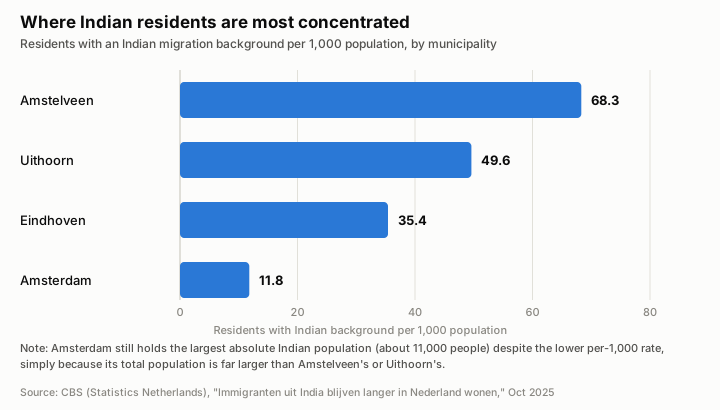
Amstelveen, a suburb bordering Amsterdam, has by far the highest concentration relative to its size, a pattern widely linked to its international schools and proximity to the Zuidas business district and Schiphol. Amsterdam itself ranks lower on this per-capita measure simply because its overall population is so much larger, but in absolute numbers it is home to the largest single Indian community in the country, at an estimated 11,000 or more residents. Eindhoven's position on this list lines up directly with its concentration of semiconductor and engineering employers, and Almere and Uithoorn both benefit from being commuter towns within easy reach of Amsterdam and Schiphol.
Which Companies Employ the Most Indians in the Netherlands
This is the one question in this article we cannot answer with a verified number, and it is worth being direct about why. Dutch companies do not publish employee headcounts broken down by nationality, and CBS does not release employer-level migration data either, for privacy reasons. A ranked "top 10" list of Dutch companies by number of Indian employees does not exist in any publicly available, verifiable source as of this writing.
One figure circulates online, an unsourced claim that around 1,700 Indian employees work at ASML's Veldhoven site, making Indians the largest expatriate group there. It appears in a small number of blog posts with no attribution to ASML itself, to CBS, or to any other primary source, so it is not repeated here as fact.
What can be said with confidence, based on sector data above rather than company-level counts, is which kinds of employers concentrate the most Indian talent: IT services and consultancy firms across the Randstad, semiconductor and precision-engineering companies in and around Eindhoven (ASML being the best-known name in that sector, without a verified headcount to attach to it), and the Amsterdam-based European or regional headquarters of multinational corporations that regularly sponsor Highly Skilled Migrant visas. If a verified, sourced ranking of employers ever becomes available, this article will be updated to reflect it rather than left to imply a precision the data does not support.
What This Means for the Community
Eight years of data point to a community that has grown fast, is increasingly putting down roots rather than passing through, and is heavily concentrated in a handful of cities built around IT and high-tech employment. That combination, more people staying longer, arriving with families rather than alone, and clustering in the same few municipalities, is exactly the kind of pattern that makes a dedicated directory and community platform useful rather than a nice-to-have. Whether you are the 56,000th person to have joined this community since 2016 or you have been here for two decades, DesiBiz exists to help you find the businesses, services, and people who already understand what you need.
References
- Migrants from India are staying longer in the Netherlands, CBS (Statistics Netherlands), October 2025
- Fewer Europeans, Indians are moving to the Netherlands, DutchNews.nl, July 2025
- Indians in the Netherlands, Wikipedia (population figures for 2016, 2019 and 2022, compiled from CBS data)
- From Bangalore to Brainport: High-Skilled Indian Migration to the Netherlands, Global Indian Times (cited only to flag its ASML employee figure as unverified, not used as a source of fact in this article)
More in this series: Festivals and community
- When Is Diwali 2026? Date and Traditions in The NetherlandsDiwali 2026 falls on 8 November. Learn why the date moves every year and how the Indian community in The Netherlands celebrates it.
- Diwali Festivals in The Netherlands: A Visitor's GuideWhich Diwali festival in The Netherlands suits you? Compare free outdoor festivals and ticketed indoor evenings, with dates and practical tips.
- Garba and Dandiya in The Netherlands: A Beginner's GuideNew to Garba and Dandiya? Learn what the dances mean, who organises Garba nights in The Netherlands and how to join in as a beginner.
- Indian Temples and Holy Places in the Netherlands: A Community GuideHindu mandirs, Sikh gurudwaras, ISKCON temples and Kerala Christian parishes serving Indian communities across the Netherlands, with addresses and visitor tips.
- Why Community Matters More Than You Expect When You Move AbroadA widely cited survey found 52% of expats in the Netherlands struggle to make local friends. Here is why community becomes the real infrastructure of settling in.
- Best Cities for Indian Expats in the NetherlandsAmsterdam, Eindhoven, Rotterdam, and The Hague each suit a different kind of expat life. Here is what actually sets them apart.
Related guides
- Get Money Back for Charging Your EV at Home in The Netherlands: ERE Certificates and Employer ReimbursementCharge your EV at home in The Netherlands? Earn roughly 10 to 20 cents per kWh with ERE certificates, plus tax-free reimbursement if you drive a company car.
- Dutch Post-Birth Traditions: What to Expect When a Baby ArrivesWhat beschuit met muisjes, geboortebord, and kraamvisite mean, and how to take part in Dutch traditions after a baby arrives.
- Best Family Day Trips in the Netherlands, Sorted by Age GroupAn age-by-age guide to the best family day trips in the Netherlands, from toddler playgrounds to teen-approved thrill rides.
More guides on Community & Culture or all guides. New here? Start here.
Stay in the loop
Get new business listings, upcoming events, community news and offers straight to your inbox.